This website is an online tool to create and run dynamic rating experiments on audio recordings.
Dynamic Rater is a web application for creating and running dynamic evaluations of speech while listening to audio recordings. Originally inspired by the study of Nagle, Trofimovich & Bergeron (2019) and McIntyre's Idiodynamic Software, it was designed to assess speech comprehensibility dynamically: raters listen to a succession of audio recordings and click a button whenever they struggle to understand the speaker.
Each click acts as a local indicator of difficulty, enabling a detailed, moment-by-moment map of perceived difficulty, going beyond traditional holistic evaluation. While built for comprehensibility judgments, the tool can however be adapted to rate any dimension you want.
How does this differ from Nagle et al. protocol? — The original Idiodynamic Software targets in-lab experiments paired with post-rating qualitative interviews. Dynamic Rater instead targets larger, autonomous rater panels through an online platform, with quantitative analysis of click activity. We also simplified the rating protocol to be unidirectional and non-incremental (no +5 to -5 scale with plus/minus buttons) to simplify quantitative analysis.
Click Pattern Analysis
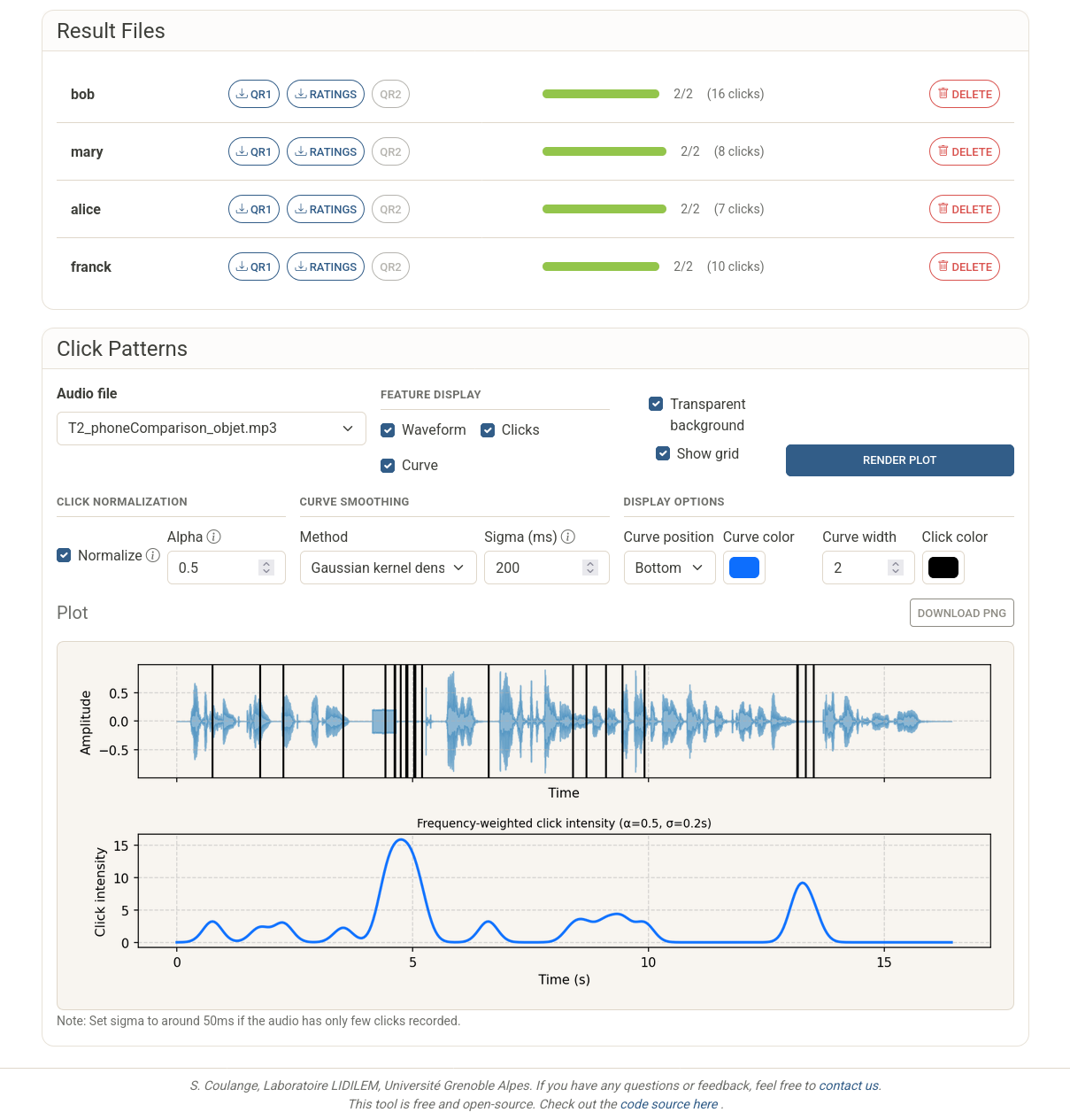
Because click behavior varies widely across raters, a rater-normalization step ensures each click contributes proportionally to that rater's overall click frequency. Click patterns are then modeled using a Gaussian kernel density estimate, where each click contributes a bump to the curve using the following formula:
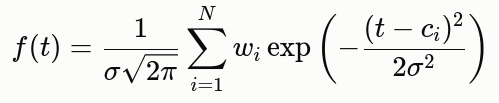
- t is time
- ci is the time of the i-th click
- wi weight of the i-th click (from inverse-frequency normalization with an α ∈ [0,1] parameter for tuning the strength of the correction).
- σ is smoothing bandwidth (in seconds)
- N is the total number of clicks across all raters.
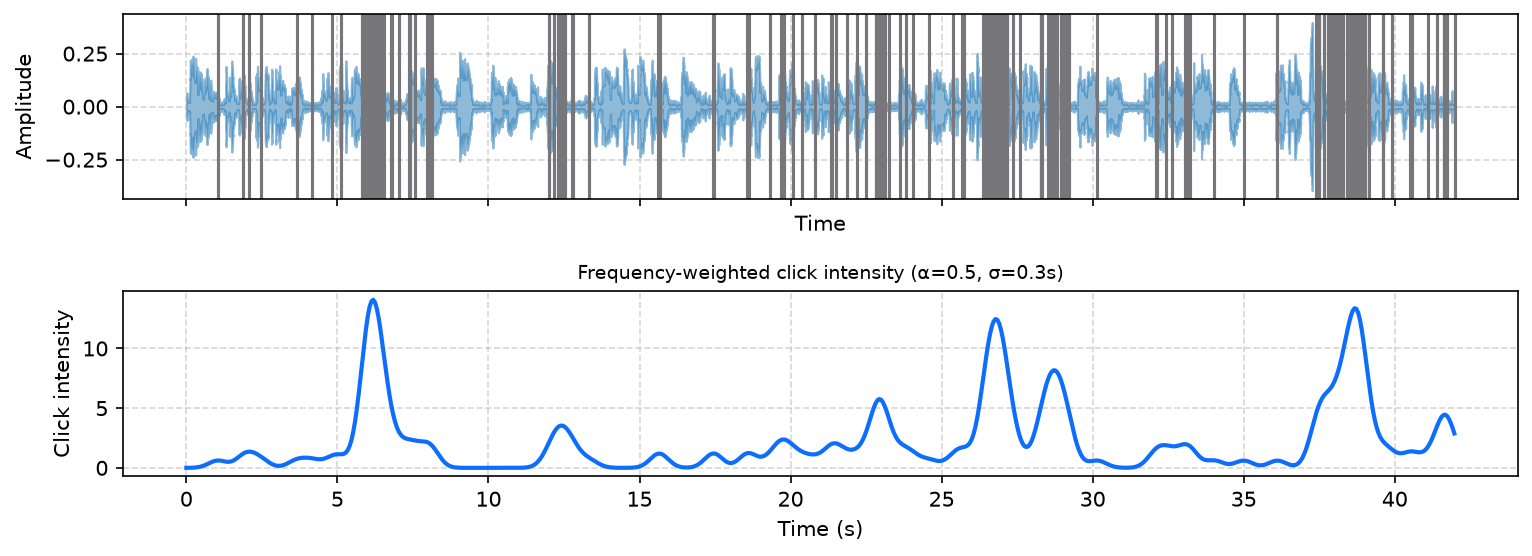
Example of a recording rated by 67 raters, each vertical bar shows one click:
Experiment Structure
Each experiment follows a flexible structure:
(optional)
(with optional training and follow-up questions)
(optional)
-
1
Welcome page — introduces the experiment to raters before they begin.
-
2
Pre-experiment questionnaire optional — e.g., sociolinguistic background.
-
3
Rating pages — raters listen to an audio recording and click whenever they wish; optional training phase and follow-up questions can be added.
-
4
Post-experiment questionnaire optional
-
5
Final page — thanks participants, with an optional redirect.
Experiment Dashboard
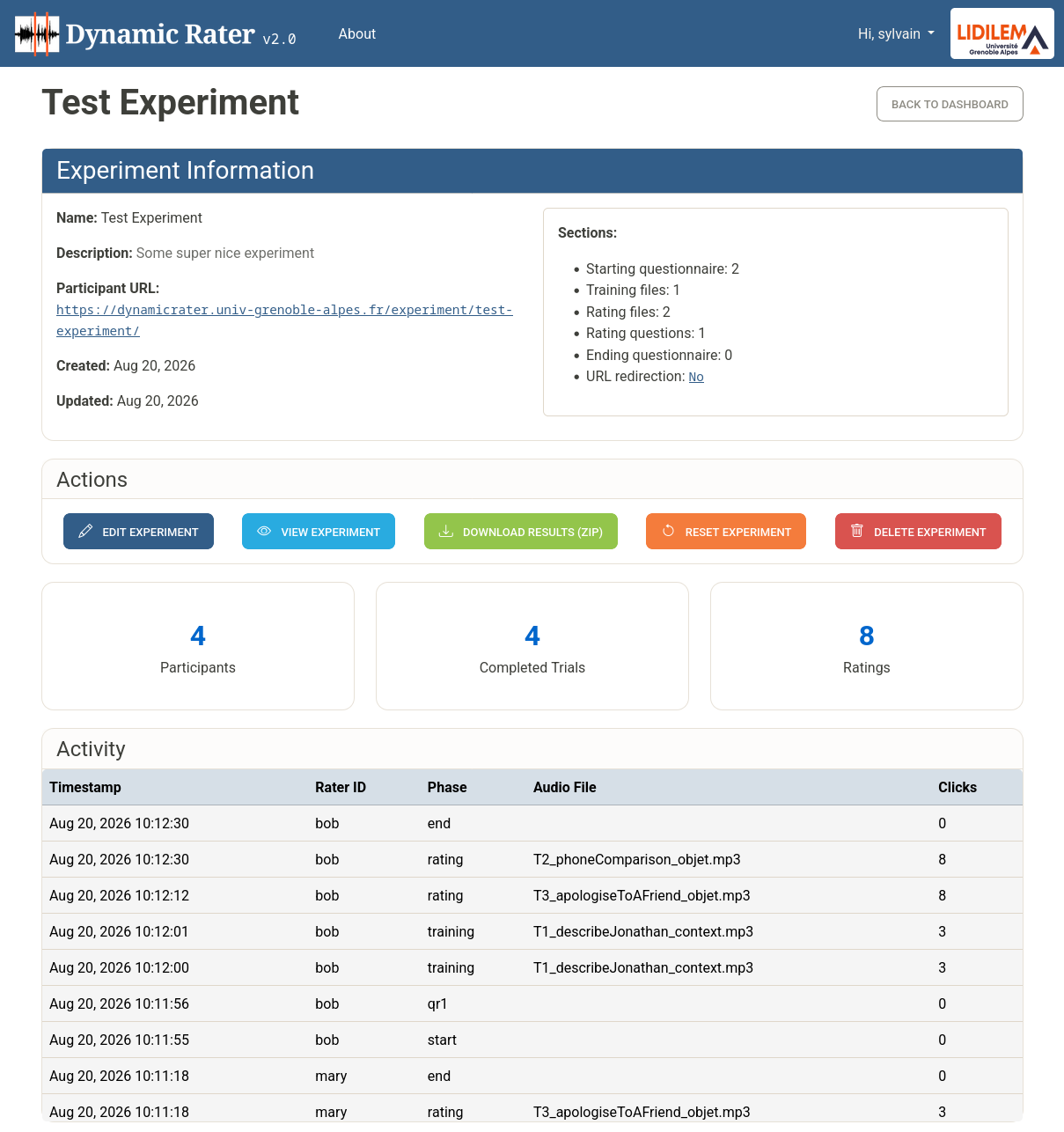
Each experiment comes with a dedicated dashboard for monitoring and managing the rating process.
Output Files 🍏
Pre-experiment questionnaire
One row per participant
Rating results
Click times and follow-up questions, one row per file and participant
Post-experiment questionnaire
One row per participant
Click positions
in TextGrid format
Click pattern analysis
in PNG format
Raw curves
As wav signals
Contact & Citation
Feel free to contact us if you have any suggestion or question: sylvain.coulange@univ-grenoble-alpes.fr
Please cite this tool if you use it in your study:
Coulange, S., Kato, T., Rossato, S., Masperi, M. (2024) Exploring Impact of Pausing and Lexical Stress Patterns on L2 English Comprehensibility in Real Time. Proc. Interspeech 2024, 1030-1034, doi:10.21437/Interspeech.2024-1627
@inproceedings{coulange24_interspeech,
  title     = {Exploring Impact of Pausing and Lexical Stress Patterns on L2 English Comprehensibility in Real Time},
  author    = {Sylvain Coulange and Tsuneo Kato and Solange Rossato and Monica Masperi},
  year      = {2024},
  booktitle = {Interspeech 2024},
  pages     = {1030--1034},
  doi       = {10.21437/Interspeech.2024-1627},
  issn      = {2958-1796},
}